Spotify celebrated its 20th anniversary this week and gave me a gift I’d long been awaiting – HISTORICAL DATA. Well, by that I mean more than the last year’s worth.
Not only did they release 20 historical global data points (things like record breaking artists & songs, genres with the most growth, lots of “all time highest” metrics), but we as individual listeners also got Christmas in May with our own listening history summary. I was really excited about this, but truthfully… I was a little underwhelmed.
Before I dive into my qualms, I’d like to preface that I am a daily Spotify user and have long had a data hardon for Spotify Wrapped. For those who don’t know/ live under a rock/ use Apple Music, Wrapped is the end of year listening summary that Spotify packages in flashy animated graphics for all its users. It reveals who their top artists, albums and songs of the year were, plus a few other interesting tidbits that change each year. The Wrapped initiative completely changed the data collection game- the “we’re watching you” Big Brother energy of tracking usage data was expertly rebranded into a viral treat that rewarded users and the company alike - the former with personal insights and shareable content, the latter with free marketing. The yearly social media bonanza that surrounds the Wrapped drop is evidence enough for how the people have eaten it up. It was a brilliant marketing move, a data enthusiast’s wet dream, and I’d argue that it’s verging on a minor cultural institution. So all that to say - I have a lot of respect for Spotify’s ingenuity with data, and I critique with love 🖤
So let’s start with what Spotify did do for us devotees on this momentous anniversary. In typical Wrapped fashion, we got an Instagram Story-esque slideshow with glittery shareable graphics of the following datapoints: my all-time total number of songs listened to, my first-ever song I listened to on Spotify (with an interactive feature to guess what it is), and then my top streamed artist of all time. This, plus a playlist of my top 120 songs ever that I can save/share/etc. I’ve pasted my “gifts” below so you can see for yourself:
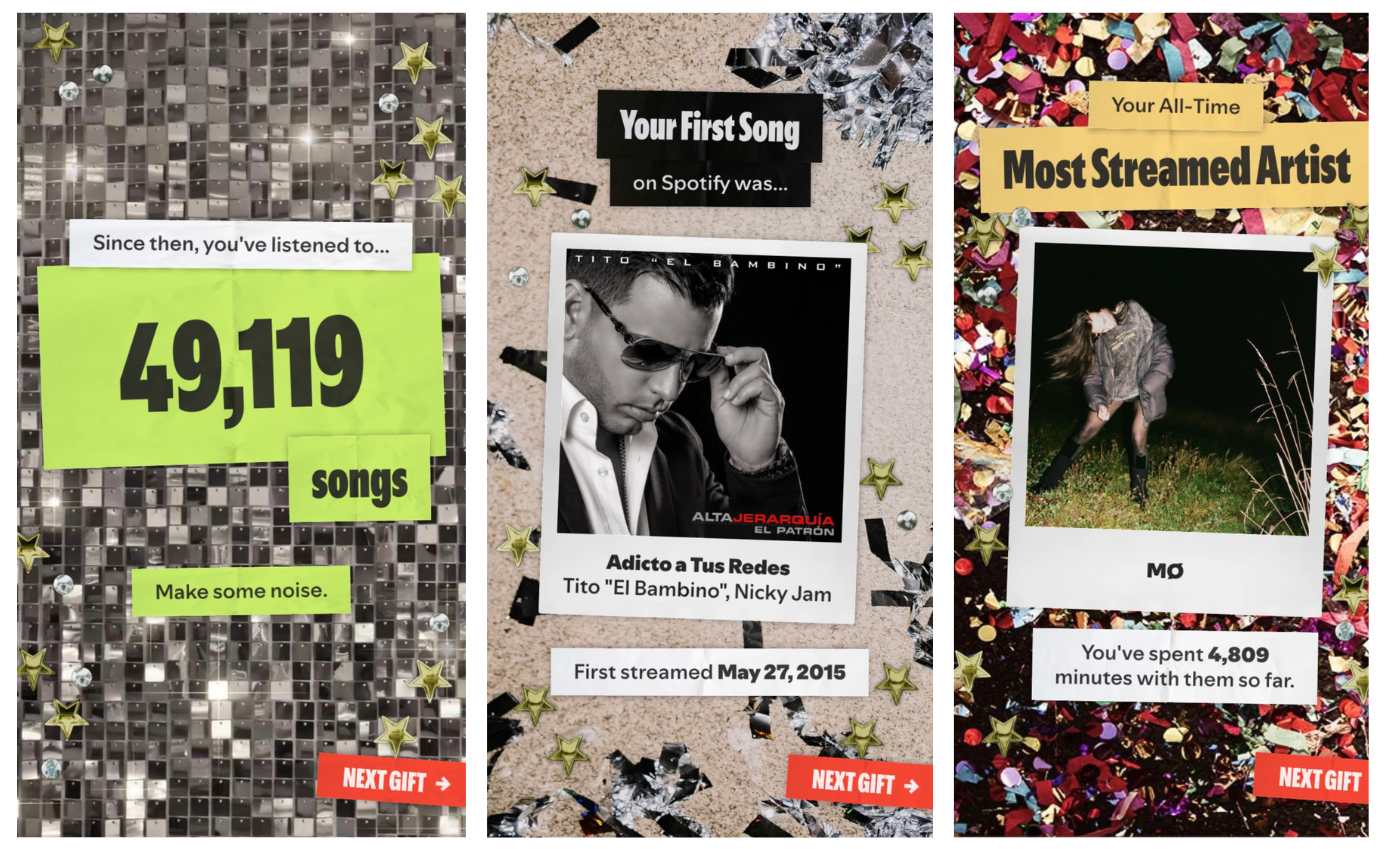
I’ll set the scene for you - It was 2015, I was studying abroad in Buenos Aires, and “Bailando” by Enrique Iglesias was the hot new song that played at literally every bar at 2am on the dot (that’s actually early for Argentinian standards, they saved the late night for Cumbia). I signed up for Spotify so I could save all the reggaeton and dancehall music I wanted to keep listening to while I solo traveled through Colombia and Brazil that summer- with only a school bookbag-sized knapsack, I might add.
So yeah, you could say I was in a pretty different place then, and not just musically (nor just in my ability to pack lightly)…To be clear, I’m not hating. I still frequently jam to my first ever playlist, “Tenés Mundo,” which heavily features my boys Daddy Yankee and Nicky Jam.
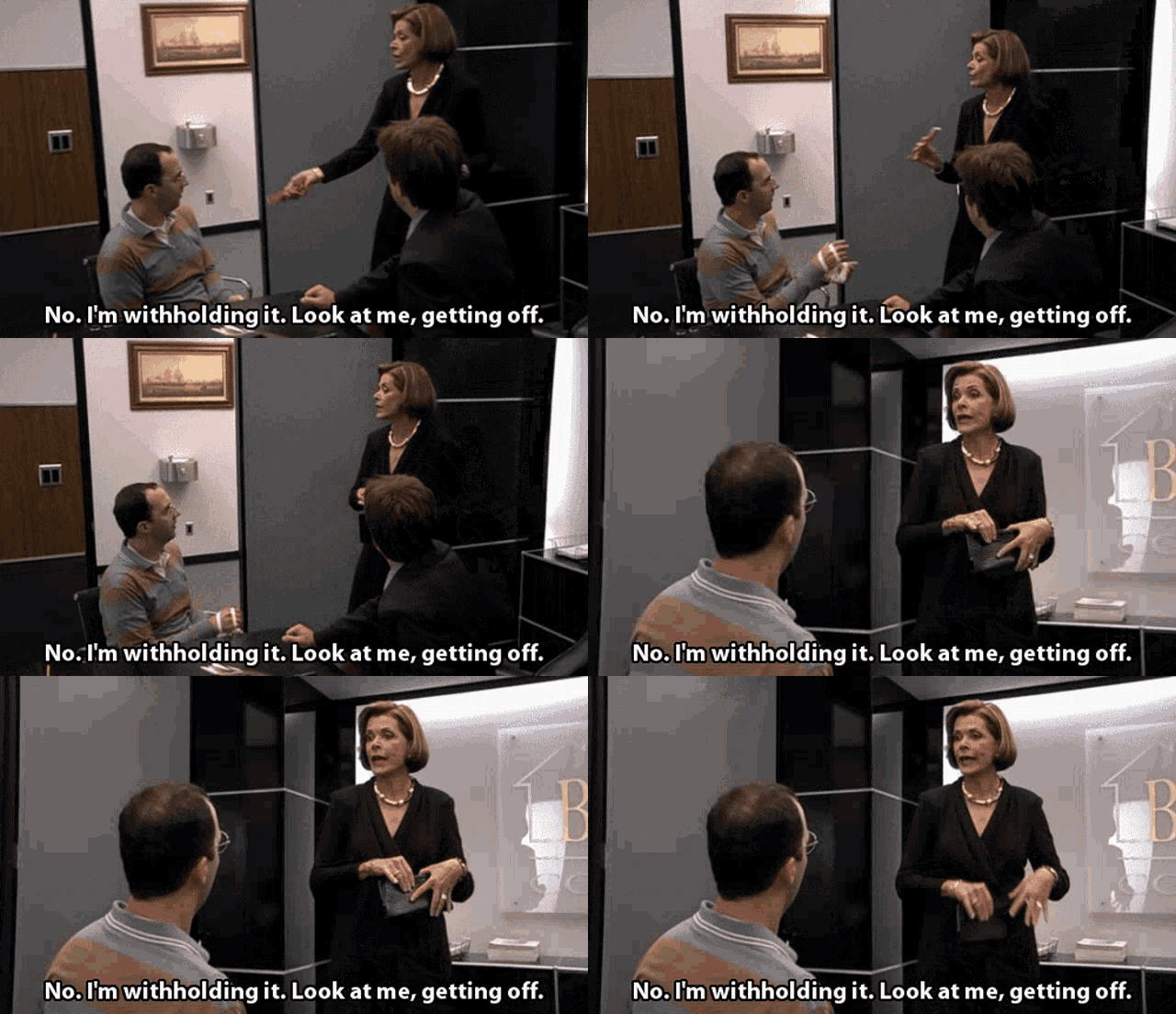
20 years is a long time for most things, people and companies, but it’s an INCREDIBLE amount of usage data -- and Spotify has now definitively proved that this data is accessible. There was always a part of me that wondered if they weren’t being more forthcoming with historical data because they simply didn’t have it. So now that I have my all-time stats, I’m convinced that they’re just getting off on being withholding.
(iykyk)
Here are the bones I have to pick, as concisely as I can make them with the amount of bluster I’m working with:
1. Context is key & I can’t find it
49,119 feels like a lot of songs. I think it is, right? Maybe? I truly don’t know, and that’s driving me nuts. Spotify should be helping me out here - they have this data on every. single. user!! This number means nothing to me without the understanding of where it sits in the broader Spotisphere (I think/hope I made that up). Even if it was a simple qualifier like “that’s DOUBLE the average user!” or something similarly vague, that would give me at least an iota of direction to shape my understanding of the significance of that number.
This is a tactic I see used all the time in marketing and sales - Impressions numbers in a campaign summary, dollar amounts in sales decks, bolded and in size 72 font but with no context whatsoever. The dirty secret is that it’s mostly depicted like this when adding context is going to hurt the story you’re trying to tell - for example, my $2M in sales sounds like a lot until I compare it to the $5M I made the previous year (these are hypothetical numbers, of course. That’d be cool though wouldn’t it..)
It’s possible that Spotify is willfully not providing context when they give us these numbers - but in this case, I just don’t see why. They could craft a story regardless of how each user measures up - either you’re adventurous and listen to a wide range of songs, or you keep your listening pared down because you know what you like. This could even be an opportunity to pitch some new music! If my number is low, Spotify could suggest playlists of songs I’ve never heard; if my number is high, Spotify could suggest playlists of completely new genres to ‘challenge’ me to take my adventurousness even further. I for one would love to see a playlist of Hungarian choral hits to expand what I think might be a broad musical palette already… (Spotify, help me out here!)
2. For the love of god, WHERE is the trended data?!
What’s exciting about a big milestone like 20 years is not just that we can know our top song of all time or our most listened to artist, but that we can see how our music tastes (both individually and collectively) have evolved over those 20 years. I’ve long had this complaint about Wrapped as well - while it’s fun to know my top artists and songs for the year overall, what I really want to know is how my music listening changed over the course of the year. Every single year I hope they include a month by month view of my top songs and artists in Wrapped, and they have yet to do so. It would be a huge opportunity for getting listeners nostalgic about different events in their lives, when their favorite artists released new albums, and other specifics that would only be reflected in a more granular approach
Some other longitudinal ideas I would LOVE to see:
A trended chart of my top yearly artists or genres across the last decade – this feels like the low hanging fruit, and I guarantee it’d get the nostalgia juices flowing
My listening momentum over the years - what was my most ‘musical year’? Do my ‘minutes of music streamed’ ebb and flow with the seasons? Tell me something about how I’ve changed over the years that no one could possibly know but you! (You = Spotify overlords)
My most ‘meaningful musical moments’ over the last 2 decades - spikes in specific songs, artists or genres. Connect that lady back to when she went on a girls trip and spent 4 hours trying to learn the TikTok dance choreography to Savage and played it 34 times in one day. Help that dude reminisce about when someone he no longer thinks about broke his heart and he listened to that James Blunt album more times than he cares to admit. Remind those siblings of when they celebrated their dad’s 60th and put together a playlist of 70s and 80s hits that they’d never heard before. Pull on the heartstrings and make us emotional goddamnit!
Superlatives: my most diverse month, my most chaotic month, my most obsessive month (when I listened to Breathless by Caroline Polachek 11 times in one day, probably)
I have a lot more ideas but I shan’t give them away for free. Spotify Data Queens, you know where to find me
3. Give me the connection I’m craving
Most of this data is about the individual user’s behavior, but there is so much Spotify could be doing with this data to help users connect with our micro and macro communities
I’ll give credit where it’s due - there are lots of collaboration components of Spotify, and they do a good job of experimenting with that. Collaborative playlists are a crucial part of how I interact with my friends - music is a love language after all.
But wouldn’t it be fun to see how different my music taste was in 2015 and compare it to my friends, family, partners, roommates, favorite baristas, random people on the street? Or to see how our music tastes have evolved alongside those other people we’ve been connected with over the years?
I think a connective component would be an awesome way for Spotify to up the ante on their data storytelling initiatives. Obviously I think it’s important that we opt in (don’t know if I want to see a whole slideshow about how my ex and I had the exact same music taste back in 2018…) but even for new friends and partners, it would be a delightful way to get a look into each other’s pasts to compare how our tastes converged, who we used to listen to, and then be able to share playlists of our historical favorites with one another. And might I add, an excellent opportunity to roast them if they happened to have listened to the Thong Song 45 times in one month (I promise I made that example up, but I bet it’s out there..the people deserve to know).
Plus if we think in even more macro terms about how this data could connect us with our communities, there’s a whole other world of analysis and comparisons. We could be getting insights about how people in our cities, our generation, our ‘Spotify cohort’ (aka in my case, people who joined Spotify in 2015) or other fans of our favorite artists are listening, and how those listening habits have also changed over the years.
Final Thoughts
All the ideas I’m pitching are selfishly for me as a consumer wanting to know these things for my own enjoyment. But getting more expansive with this data would be a win for everyone - the more we learn about ourselves with Spotify’s data, the more Spotify gets the benefit of our participation and our continued enjoyment & support of their brand. Plus, they would continue paving the way in their historic legacy of packaging usage data to reward their subscribers with delightful data stories that make them feel special and interesting, and fuel their users’ desire to continue listening on Spotify specifically.
I’m sure there’s a lot of work that would need to be done on the backend to make plenty of these insights possible. However, with AI’s ability to synthesize widespread data insights with mega efficiency, I think we as paying subscribers should be expecting much more of this type of insight as part & parcel of the tradeoff we opt into by using a platform that tracks our every (musical) move. I love Spotify’s commitment to using data as a means of connecting with subscribers. But I hope that we see more of a push towards initiatives that are given proper care and context to tell the most interesting stories, and most importantly to lean into the ways these stories can help us connect with our memories, our nostalgia, and our communities.