I conducted an experiment last year where I went full Virgo mode on my new years resolutions - inspired by a friend’s “25 for 25” list she kept in her phone, I also made a list of 25 goals for my year. Then I went a little buckwild and added smaller goals items within each of these, resulting in a 79 point list of resolutions.. welp. But I kept it in the Notes app on my phone and I updated it monthly (sometimes more!), so I felt like I actually paid attention to my resolutions all year long because of it.
I closed out the experiment with a thorough analysis, as I am wont to do, to get a sense of how well it went and to inform how to structure my 26 for 26. I may have gone a little crazy with this analysis - not only did I reflect & journal about each resolution, I also decided to make a spreadsheet (gasp!) of all the goals and sub-goals, and rank each by how measurable it was, my level of success (more on that later) and whether or not to repeat the goal in its same form. Yep, I know how to have fun.
My Analysis
I’m sure most have heard of the SMART framework for setting goals - but just in case, it’s an acronym that stands for Specific, Measurable, Achievable/Attainable, Relevant, and Timebound. I applied a rating of measurability to each goal from 0-5, based on how many of these attributes the goal achieved. My success rating was also 0-5, zero meaning not accomplished in the slightest, 5 meaning completely and unquestionably fulfilled, and the numbers in between to allow for some caveats / gradients of success. I also added a column for whether I would repeat the goal exactly as it was, add more measurability, take away measurability (keep it ‘fuzzy’/broad), or unsure/wouldn’t repeat (assuming these were all resolutions I’d do again). The final categorization was whether it was an ongoing goal (like “make time for reading”) vs. a “one-off” goal (like going to a book club event or finishing a book).
A small peek into the organized insanity of this spreadsheet
Obviously I am applying a mode of analysis to something that has a lot of nuance and context - a “one off” goal can be as small as buying an alarm clock and as big as running a half marathon (yes those were both sub-goals this year). So while I love putting things into columns and categories, I acknowledge this method of quantifying goals is inherently limited.. thus the quant analysis cannot exist on its own without a little added color based on my ~thoughts & feelings~
Learning Goals:
The big picture
What story do the numbers tell? Does this align with how I feel about my last year?
Measurability & Success:
How did measurability impact my likelihood to achieve the goal?
Does tracking data feel like a good representation of success for New Year’s resolutions? Does the context feel represented accurately?
How does data/finite goals affect accountability?
What are the downsides to measurability in this particular venture?
Feelings:
Does the completion (or lack thereof) of the measurable sub-goals correlate to my feeling of success vs ‘failure’ (yeek) on the broader topic/resolution?
What felt good about the measurement style, and what didn’t?
Examples:
What types of goals work best with accountability? Which don’t?
What are examples of note that had an interesting outcome?
Future Planning:
What approach should I take for my 2026 goals? What is left to learn/experiment with that I can enact this year?
The Results :
I could write an entire book on this subject as it turns out, so I’m attempting to keep my summary brief and won’t go into every answer in depth, but want to highlight the big learnings and takeaways.
Big Picture
Overall my rate of success was strong - 75% of my goals were between 3-5 on my rating system. I only had two that I ranked as a complete 0 (no progress whatsoever), so for having a whopping 79 goals I was able to stay on top of them pretty well! This data point aligns with how I feel about last year - I think I would have assigned more 5s if I had kept my goals a little more achievable/streamlined, but more on that later.
Measurability & Success
There is no question that measurability helped keep me on track for a lot of goals, and the ones that were much broader and less defined had a lower success score. There’s a clear relationship between a higher SMART score and a higher level of success. This doesn’t always tell the whole story, as predicted - I know that certain goals just became less of a priority for me throughout the year as well, and on those I gave myself more lenient success scores.
Having structure was paramount for accountability, especially when I knew a goal was going to be a challenge, but the downside was that I sometimes got bogged down in the details or allowed it to stress me out. The best example of that was phone usage. I decided to track my phone screen time throughout the year and aimed for a 5% decrease per month. I knew that was a very aspirational goal, and that it likely wouldn’t be linear - which is exactly how it panned out:
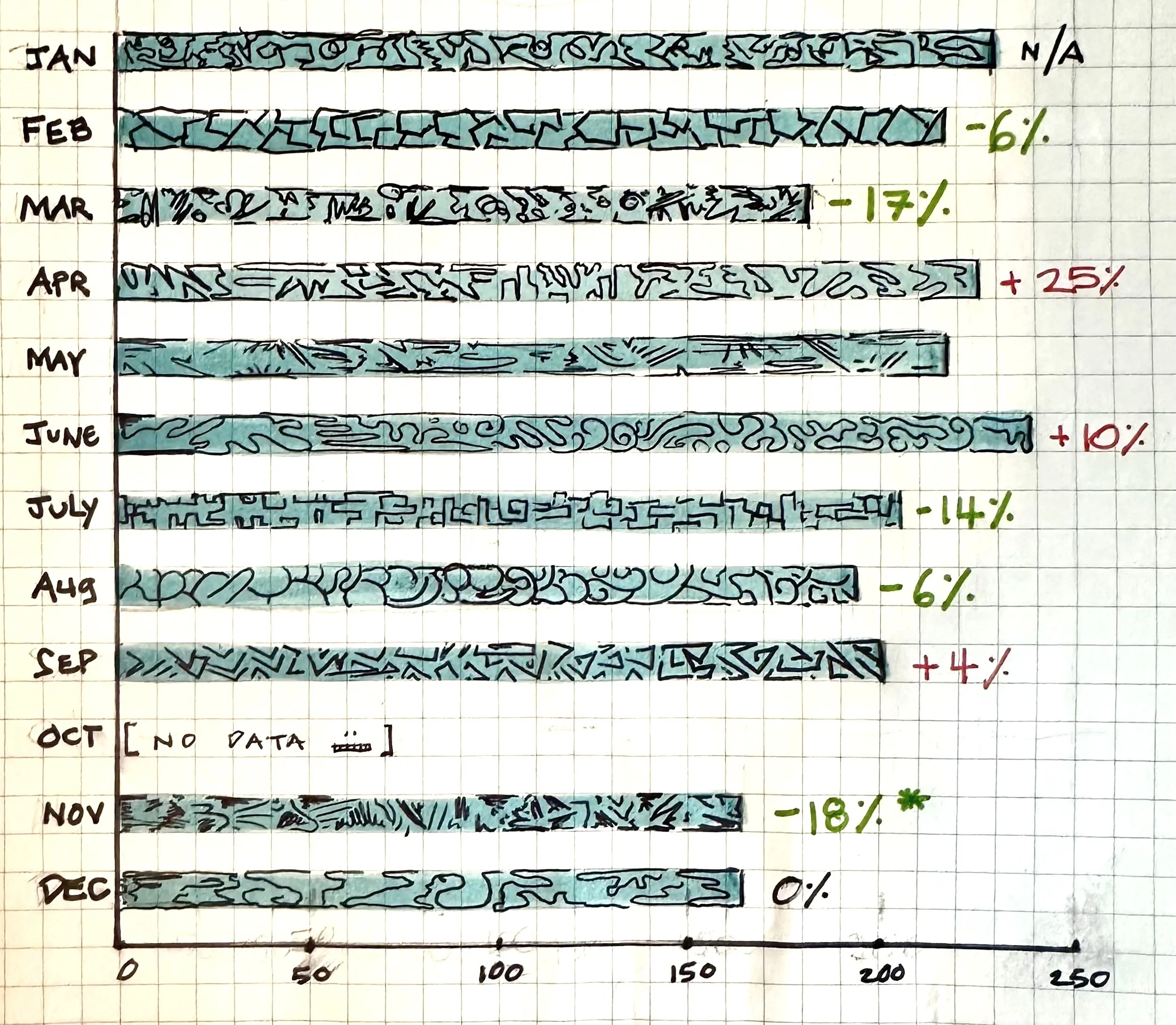
My attempt at visually tracking my screen time (please forgive the smudge marks)
The average delta for the year was -3% which was pretty close to my goal, so I felt happy with that. I knew there would be weeks/months of higher usage and it wouldn’t be a pure downhill trajectory. The other thing I didn’t anticipate was how hard Apple makes it to keep track of this data - it turns out you can only go back 4 weeks for screen time, so if I ever forgot to write it down right away I lost the data forever (hence the entire month of October not being accounted for… oops.) But the main thing I started struggling with was worrying about keeping my screen time low instead of prioritizing things that actually mattered more to me, like facetiming with my nephew or a friend. I didn’t like that I was so beholden to this data that I’d be worrying about that when using my phone for things that actually matter to me, like connecting to people I’m close with (the original use case of a phone as it turns out!) But on the other end of the spectrum, it did make me take concrete action to decrease screen time, which helped develop better habits around using my phone. My favorite habit I adopted was leaving my phone in another room during deep work periods. Any time I had an instinct to reach for my phone, I’d write down what I wanted to do with it, and then give myself designated phone periods throughout the day to do those tasks in bulk and then put the phone away again.
I won’t be repeating this goal primarily because of how annoying it was to track, but I am glad I got myself into the habit of being more aware of how often I was picking up the phone during the day. My default is to be more conscientious now, and I usually opt for reading a book or a magazine instead of scrolling on my phone when I have downtime.
Feelings
It was overall really helpful and positive to have this living breathing tracker of all the things I was working on throughout the year, and having smaller fun items to be able to check off mixed into bigger/harder/scarier ones made a big difference in making it enjoyable while feeling like I was making progress. The data was nice to have to show myself that I’d accomplished or improved on something over the course of the year, but if I fell off of a goal or didn’t accomplish something it felt less great having that as a reminder. This all comes back to making the goals achievable/attainable, which I think was one of the areas I was weakest in.
A good example of this was my dating goal - I wanted to prioritize making time for meeting a potential partner, so I set a goal of 4 dates per month. I started the year off strong, but then realized this was not achievable with the amount of travel I planned most months of the year. Additionally, this dovetailed with the first issue of tracking numerically that I had with the phone usage - it was a good way to make my goal of “making time in my life for finding a partner” measurable, but I was starting to go on dates just for the sake of achieving the monthly quota instead of making plans that felt like they’d actually result in a meaningful connection.
Biggest takeaways:
Measurability is helpful but not always necessary depending on how prone you are to do something naturally. Make choices accordingly:
If something is a big priority and you know it’s going to be tough to get done or it won’t come, lean heavily into SMART methodology
Fun things that are less high stakes can be broader/ fuzzier
When there were zero measurable/specific goals, progress was significantly lower (didn’t end up keeping notes or tracking in any way, so it looks naked at the end of the year)
Start with small, achievable goals for things that are nice to have - those are meant to be fun, and i felt disappointed / stressed when I looked at them and felt I’d underdone it
Data/measurability was invaluable for accountability and keeping things top of mind, but could lead to stress or take away focus from the big picture
Some activities i wouldn’t repeat but acknowledge that the data driven aspect helped me stay accountable, but in other instances also frustrated me & stressed me out - it made me lose track of big picture and I got bogged down in the details
The data doesn’t always fully capture the success story - in some cases I went above & beyond on certain goals, but the data just shows what was completed vs wasn’t
Best method of measurability depends on the type of goal: For ongoing goals, it’s harder to apply & maintain measurability without making it stressful. I also learned that goals around creative projects are better as time-focused goals instead of completion goals (the amount of frustration i could’ve saved myself by just saying “spend x hours on painting” vs “finish this painting”...)
Start smaller than you think: To decrease stress and fixation, it’s better to err on the side of more achievable. If making lists like “do this activity x times this year”, start with a reasonable number and then decrease it
Mix finite & continuous goals: I noticed that having a few “easy” goals to check off within a broader subject helped me feel like I was making momentum and give me the satisfaction/motivation to keep prioritizing it
My Plan for 2026
I’m still going to maintain a 26 for 26 this year, but I am making it a little less daunting. 26 goals is already a lot, so I want to streamline my focus and do fewer sub-goals within goals.
I want to implement more of a value/priority based SMART system, i.e. get granular and measurable with the goals that are top priority and let the nicer to have ones be fuzzier and less structured. Given how clear the correlation between measurability and success is, I’ll use that insight to make sure I accomplish the things that are most important to me. Especially if I know a goal is going to be a struggle, that makes it even more important to add accountability. I am going to focus on making these goals as achievable as possible, and likely start smaller than I think I need to in order to set myself up for success.
Thanks for going on this journey with me! If you have any methods you find helpful for accountability and structure when it comes to setting goals at the beginning of the year, I’d love to hear them!
’Til next time!